

By Jeanine Behr Getz
A Seven-Day Journey Through the Land of a Thousand Hills, its Renewal and Misty Mountain Gorillas
Rwanda is one of Africa’s most densely populated nations, home to roughly 14 million people, yet the smallest nation by land area – think Maryland in size, but with twice the population. Despite this, the country feels spacious and alive; every inch of land has purpose and stands out for its “waste not, want not” ethos.
Schools are rising across the country, and the sight of smiling children in crisp uniforms walking along dirt roads is a powerful symbol of hope. In villages, neighbors share tools, chores, and labor; cooperatives empower women and young entrepreneurs to start businesses while preserving cultural traditions and skills. Streets are remarkably clean; a reflection of both government policy and community pride. Plastic bags are banned nationwide, and once a month, citizens gather for Umuganda, a National Day of Community Service dedicated to cleaning and beautifying neighborhoods. Visitors notice immediately: Rwanda shines with an order and tidiness rarely seen elsewhere in the world.
Perhaps the most remarkable part of Rwanda’s story is how much ownership its people have taken in shaping their own recovery. Foreign financial aid provides resources, but it’s the discipline, accountability, and collective will of Rwandans that have turned those resources into results. Leadership has ensured that investments are directed with efficiency and integrity, translating outside support into tangible progress on the ground.
The “Land of a Thousand Hills” feels vibrant and forward-looking, a place where resilience is woven into the landscape as surely as the terraced fields that cling to its slopes. So, don’t only go to Rwanda for the unforgettable mountain gorillas, also go for the spirit of a nation that has chosen not just to heal, but to lead.
Day 1: Arrive Kigali Airport, Eastern Rwanda, via Doha, Qatar on Qatar Air
After a 19-hour journey from JFK, we touched down in Kigali, Rwanda’s vibrant capital. Our guide, a warm-smiling Rwandan named Abbey, greeted us with the traditional “Muraho!”
Trying to keep jet lag at bay, we dropped our bags at the hotel and set out to explore the city. Kigali immediately impressed with its vitality; modern buildings rise alongside colorful markets, streets hum with the energy of people walking, transporting goods on bicycles and motorbike taxis, and a palpable sense of forward momentum.
Our first stop was the Kigali Genocide Memorial, a profoundly moving and sobering introduction to the nation’s past. In 1994, Rwanda was torn apart by a genocide that claimed the lives of approximately 900,000 people in a hundred days. It was impossible to walk through the exhibits, reading names and stories, and seeing the memorial gardens without feeling the weight of history. It was a humbling reminder of both the depths of human cruelty and the resilience of the human spirit.
Rwanda immediately felt like a place of both reflection and renewal, and its people have turned those wounds into lessons in unity, forgiveness, accountability, and progress.
Day 2: Akagera National Park, East Rwanda, on the Border of Tanzania
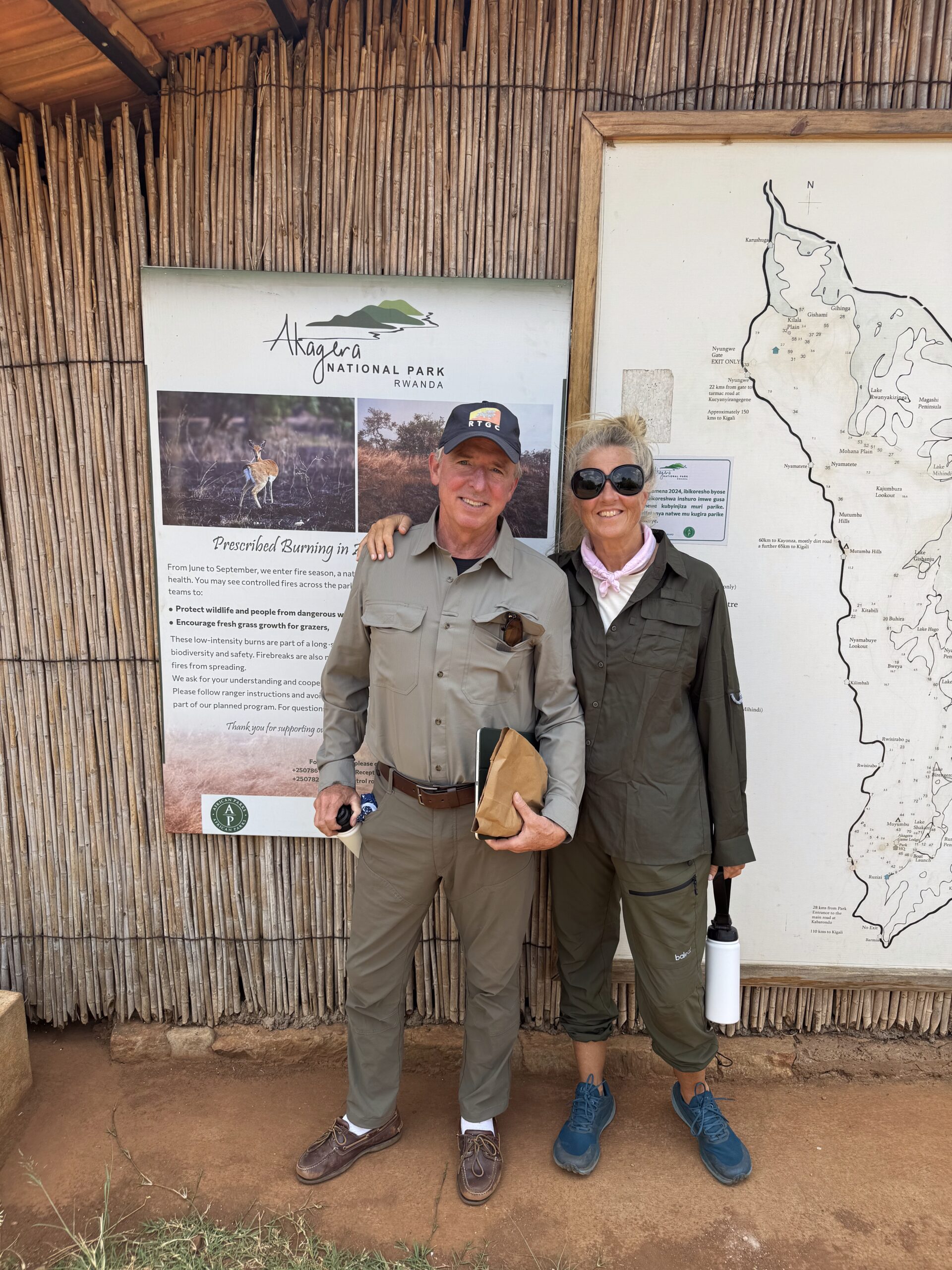
The alarm rang at 5am, marking the start of an ambitious day. We set out for Akagera National Park, Rwanda’s first and only savannah park, about three hours east of Kigali. As we drove, the sunrise spilled across rolling hills of terraced farmland and rushing rivers, illuminating the daybreak bustle of Rwandans beginning their twelve-hour workday.
As the landscape slowly flattened, banana groves gave way to wide grasslands and acacia trees — the unmistakable prelude to the African bush. By the time we reached the park gate, the air felt drier, the light sharper, and the anticipation was real. A ranger greeted us at the gate, requiring us to check in before we rolled forward into Akagera’s wild expanse; 750 square miles of lakes, savannah, and woodlands teeming with life.
Akagera is home to the Big Five — lions, elephants, buffalo, leopards, and rhinos — as well as over 500 bird species, zebras, giraffes, hippos, baboons, bushbucks, impalas, and more. We watched zebras grazing alongside impalas, hippos peering from the lake, and lions napping in the morning sun. In the distance, the unmistakable forms of rhinos moved gracefully across the open grasslands. The experience was both thrilling and serene — a perfect reminder that Rwanda’s landscapes are as diverse as they are beautiful.
Although it had been an early start and a long day, seeing Akagera’s vibrant ecosystems firsthand was a must. I would recommend an overnight stay at Magashi Camp, to experience a night safari, a boat safari, and perhaps a sunrise balloon ride.
Day 3: Off to Volcanoes National Park (VNP) Region and the Twin Lakes Hike
We departed Kigali early for Musanze, winding along highways that climbed into the Virunga foothills. Clouds skirted the steep slopes, and the road threaded through Gakenke District, past banana plantations, terraced fields, and villages where Rwandans were busy transporting goods to market. The drive felt like a meditation, each bend offering a fresh vista of green. A curious and recurring sight along the way was the “mattresses” nestled in the tree branches; traditional beehives woven from reeds and bark. These hives are part of Rwanda’s centuries-old honey culture, still thriving in Gakenke, where beekeeping sustains local families and produces golden honey prized for its purity and medicinal value.
By midday, we reached Musanze, the gateway town to Volcanoes National Park and the mountain gorillas. From there, we set out in the afternoon for a hike above the Twin Lakes – Burera and Ruhondo – on the outskirts of the town near the small village of Gitare. The lakes, shimmering at the base of Mount Muhabura near the Ugandan border, mirrored one another, separated by a narrow strip of land. Their blue waters glistened beneath misty hills, creating a scene both serene and almost surreal. We broke the stillness by skipping stones with a few local children, whose laughter and joy needed no translation.
We laid our heads to rest at The Bishop’s House. The service here is otherworldly – staff anticipates your needs before you voice them, every meal is a revelation, and warmth radiates from every interaction. It’s a rare kind of hospitality that transcends luxury.


Day 4 – The Bisoke Hike — Into the Heart of the Virungas
Our morning routine for the next several days began with a 5:30am rise, breakfast, and a 6:30am departure to the Volcanoes National Park trek headquarters. Imagine 50 green Land Rovers caravaning through villages, carrying 140 trekkers from multiple area hotels, all heading to the same 7:00am roll call. Between guides, drivers, and hikers, the sea of khaki and olive green made it look like an Abercrombie & Kent convention.
Side note: it’s recommended to wear khaki or olive to blend into the habitat and avoid tsetse flies. Although we didn’t encounter any tsetse flies in the mountains, and gorillas see only limited colors, it’s still better not to risk blue or black.
As Abbey checked us in, presented our permits, and secured our certified guide, we grabbed a coffee, chatted with fellow hikers, and used the last of the known “facilities” before setting off for hours. Each hiking group is assigned a trained, certified guide, sometimes paired with additional trackers, whose qualifications include a four-year degree, wilderness navigation, high-altitude safety, first aid, and a deep understanding of the local flora, fauna, and conservation rules. In addition, two armed rangers accompany every group within the park borders for safety and wildlife protection.
After our guide assignment, we hopped back into our truck and drove 45 minutes along what could only be described as a dirt-and-rock rollercoaster road. When we finally reached the trailhead, our group of ten hikers was greeted by our leader handing out walking sticks, artisans hawking their wares, and porters lined up eagerly, hoping to be chosen for employment. These porters are local community members and members of the official Porters Association, vetted to assist visitors with gear, provide support on steep or muddy sections, and “lighten the load,” though they are not qualified to act as guides. Hiring a porter isn’t mandatory, but it’s strongly encouraged, both to make the hike easier and to support the local economy.
By 10:00am, we finally began our 4,265-foot ascent to Mount Bisoke (~12,175 ft). Bisoke is part of the Virunga volcanic chain – one of Rwanda’s five major volcanoes and the third tallest. Its name, Bisoke, means “soaked in water,” a nod to its deep blue crater lake.
The climb was strenuous. At high elevation, every step demanded extra effort, and depending on pace, trail conditions, and group stops, this hike can stretch from six to eight hours. The first couple of miles wound through community farmlands before reaching the park entrance, where our armed ranger escorts joined us. From there, the trail quickly climbed through bamboo forest, then Hagenia and Hypericum woodlands, and finally into the lofty lobelia and senecio-scrub zone near the summit.
At the top, the weather shifted suddenly, and we were socked in, catching only a sliver of the famous crater lake below. Our summit celebration was cut short by thunder and ominous gray clouds. We rallied our porters and began the descent, which soon turned our already steep trail into muddy pools and rushing waterfalls. Every step became part slip, part-controlled slide. Still, the hike took six hours.
Mud-caked, exhilarated, and exhausted, we loaded back into the truck and headed to Sabyinyo Silverback Lodge, one of the first community-owned luxury lodges. I didn’t think the views, service, and food could get any better… but here, they did. What a stay!
Day 5: Ngezi Lake Nature Hike and Life-Changing Red Rocks Community Experience
We woke to a doorstep piled high with sparkling clean clothes and shoes. Our mud-caked shoes, barely recognizable from the previous day, were returned cleaner than the day we bought them. Service extraordinaire. I digress…
After the intensity of the Bisoke climb, we pivoted. Instead of our scheduled Mount Sabyinyo ascent, we opted for a gentler four-hour nature hike, followed by an afternoon cultural experience at the Red Rocks Community Center.
Only two of us were at the trailhead at 9am to start our hike with our guide, carved walking stick in hand. Within minutes though, three smiling, unsolicited porters joined us, word must have traveled quickly that we were “big tippers!” We happily embraced the hustle.
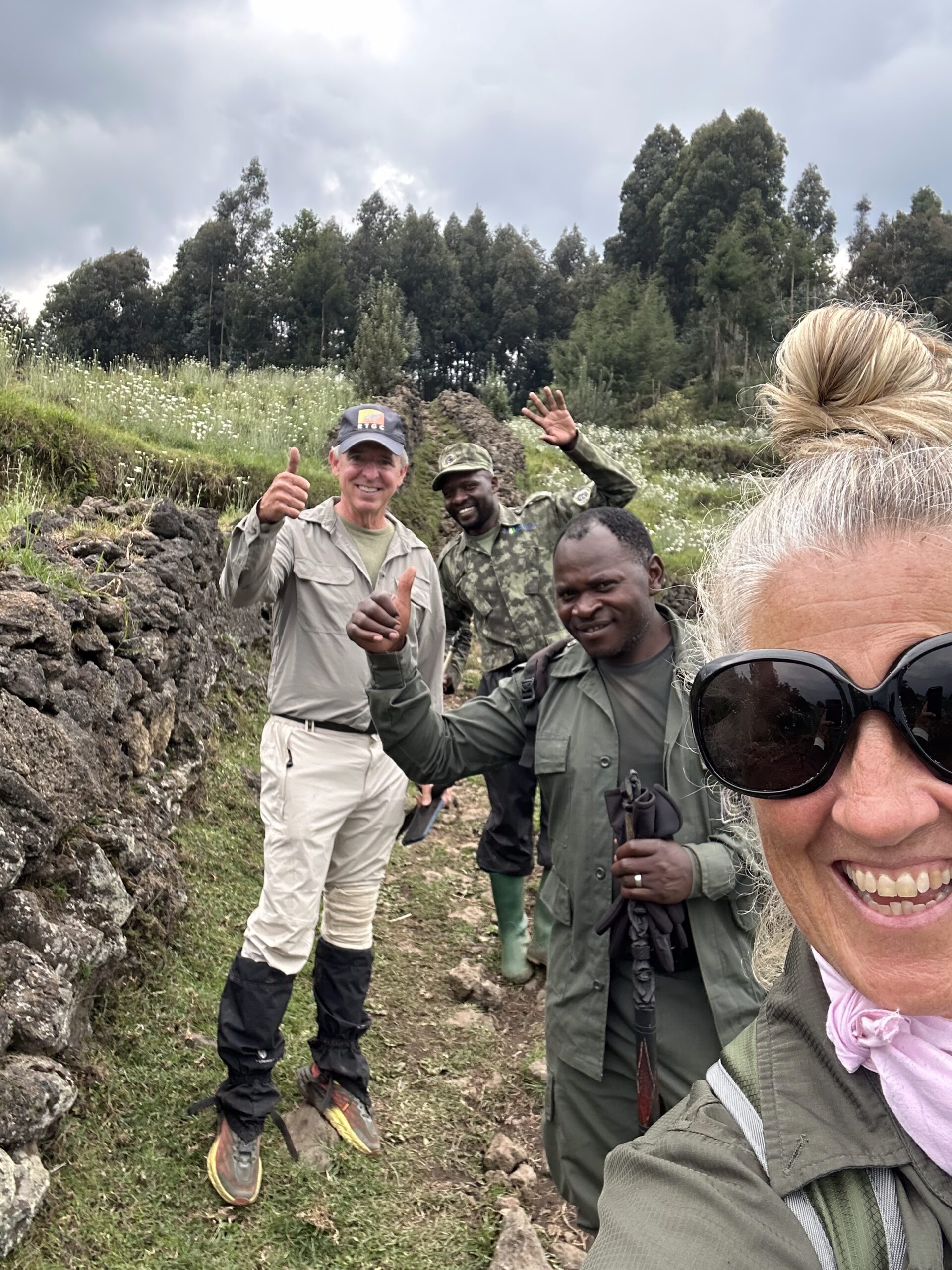
The morning began sunny, but clouds had moved in by the time we reached the Lake summit. Good thing for my long pants, shirt, and gardening gloves, stinging nettles are the biggest enemy on these hikes. The first mile wound through fields of pyrethrum, garlic, cabbage, and potatoes. Goats and cows grazed as women toiled with infants tied to their backs, while children ran around shouting “hello” and “muzungu.” The park is surrounded by farmers’ fields, separated only by 12-foot-high volcanic rock wall that runs around its perimeter. In some sections, buffalo toppled the walls like a Jenga game. Even in low visibility, wildlife came alive around us: elephant nests, gorilla nests, bushbuck, and lively golden monkeys leaping from branch to branch. Across a small valley, barely visible, we glimpsed our first mountain gorilla group, including a silverback slowly descending the mountain…a surreal, unforgettable encounter and an exciting prelude to our big gorilla trek.
Lake Ngezi itself, tiny and shallow, is nestled amid extraordinary habitat. The surrounding papyrus marshes host rare birds, including the Papyrus Gonolek and Grauer’s Swamp Warbler, while the trail offers dramatic views, on clear days, of the Virunga Massif and the peaks of the Democratic Republic of Congo. The mist lent an ethereal quality, making the experience feel intimate and otherworldly.
After our hike and a hearty lunch, our adventure shifted from nature to human connection. We drove to Red Rocks Community Center… a Rwandan MUST do! This initiative provides many ways to experience Rwanda, its traditions, and trades. We chose “A Life-Changing Experience,” spending half a day with a Rwandan family. Pauline, the woman of the house, met us at the center, and along with a translator, we walked 45 minutes back to her home, fully immersed in her daily life and the rhythms of village living.
After a brief visit in her home and an introduction to her daughter, Harriet, I was adorned in a kitenge, and we got to work. Loaded with two buckets each, we started a one-kilometer walk to fetch water – a task most families perform three times a day. We didn’t need a translator to absorb Pauline’s joy for life, pride in her family, dedication to her community, and sense of purpose. Back at the house, we excavated dirt and clay, mixed it with our fetched water, and made bricks to build an indoor kitchen. Next up, without pause, in bare feet and balancing a basket of maize kernels on my head, we followed Pauline into her field to plant crops. On the way back, we picked weeds to feed their livestock – nothing goes to waste. Throughout our visit, we listened to their stories, gaining a deeper appreciation for life in their community. Robert even indulged in a celebratory banana beer; a small, joyful moment amid a day of hard work and discovery.
By early evening, we returned to meet Abbey at the community center, awed by a day of wilderness, wildlife, and intimate human connection. It was a day that reminded us travel in Rwanda is not just about sights, but about people, shared labor, and unforgettable moments that linger long after you leave.
Day 6: The Gorilla Trek — Heart-Stopping Moment
I’m thrilled you’ve indulged me this long! Now, on to the mountain gorillas…
Although there was plenty of high drama on our trek, I’ll spare you the details and jump straight to our final ascent to see a rarely visited research group — the Kuryama family. Their lineage traces back to the legendary silverback Titus from Dian Fossey’s era. It felt like stepping straight into gorilla history, making this behind-the-scenes encounter all the more extraordinary. Truly, a privilege we’ll never forget.
Before I gush about coming within 12 inches of a silverback, having a fashion-forward female teenager reach over my head to try to grab my sunglasses, or locking eyes with a feisty one-year-old blackback, let me explain how this hike comes together.
The VNP and their certified guides pride themselves on ensuring that every visitor sees a gorilla. There are three levels of treks: easy, moderate, and hard. Even if you cannot hike, there is a Cleopatra-style stretcher and eight porters ready to carry you. By the time you check in at 7am, trackers are already climbing all over the mountains, radioing back to headquarters to identify which gorilla families are where and how accessible they are as group assignments are being made.
Each gorilla hiking group comprises six to eight hikers, one certified guide, porters, machete-carrying trackers, and armed park rangers. Every visitor wears a mask (to protect the gorillas from human diseases), and packs and walking sticks are left at a safe distance.
Fun facts:
1. Humans and mountain gorillas share 98% of the same DNA.
2. Each gorilla has its own nose print, similar to a human fingerprint.
3. There are 40 known habituated mountain gorilla groups (~1,063 individuals) in the world: 12 in Rwanda, 18 in Uganda, and 10 in DR Congo.
4. Mountain gorillas cannot survive anywhere else in the world, including zoos.
5. Mountain gorillas live at 8–13k feet.
6. Male gorillas are born blackbacks; at 12–15 years, their backs turn silver, signaling maturity.
7. Adult males weigh 350–450 pounds; females weigh 150–250 pounds.
8. They are herbivores, eating 8–12 hours a day. Silverbacks consume 35–40 pounds of leaves, stems, roots, shoots, bark, fruit, and flowers daily, while females eat 25–30 pounds.
Back to business: after we dropped our bags and masked up, we made our way uphill through thick, macheted brush, following the trackers closely. Our first sighting was a youngster swinging from vines and a less dominant silverback eating a two-inch-thick shoot like a mozzarella stick. We froze, our first sighting, we were eager to capture every second on film and to memory. We kept on.
Lagging behind the group, I accidentally started up the wrong trail and head down, walked face-first into a silverback coming down. I remained calm and retreated quickly without turning my back to him. My heart thumped, my camera rolled, as this ginormous creature passed by without incident, closely followed by our guide, ensuring he didn’t turn back.
Now our adrenaline was rushing. The trackers followed the silverback to his nest, and we followed, beginning our official one-hour visit. There they were – a family of mountain gorillas, majestic, peaceful, and unbothered by our presence. Researchers had just been studying them for several days. There were seven in this group; their black fur glistened, and their eyes were piercing as they sprawled across a flattened 6 x 20-foot area. This sampling of the Kuryama family included a three-week-old being cradled and loved up by its mother, a mischievous one-year-old using his mother as a trampoline, and two curious teenage females – one fascinated by sunglasses, the other busy grooming the silverback lying on his stomach in the middle of the nest. The silence was thick, reverent. Over the next hour, we watched them forage, groom, play, and rest. Our guide communicated with them in grunts while whispering to us about their habits, stories, and how conservation efforts had brought them back from the brink of extinction.
My heart raced. My soul quieted. I thought of how the wild keeps us humble.
To commemorate this once-in-a-lifetime adventure, I bought a hand-carved gorilla carrying her baby from a local craftswoman stationed at the trailhead.
Mountain gorilla tourism in Rwanda is a powerhouse, it generates approximately $72 million USD annually, more than half of the country’s tourism revenue. It is said to sustain over 10,000 jobs, from guides to craftspeople. Each trek ($1,500 USD per person/per day) also supports schools, healthcare, clean water projects, and provides communities with a tangible reason to protect these incredible animals and their misty forest homes.
If possible, when planning your trip, consider adding a second gorilla trek to your itinerary.



Day 7: Dian Fossey Museum & Return to Kigali
Our final day in Rwanda began with a reflective visit to the Dian Fossey Gorilla Fund International Museum in Karisoke. Often confused, remember: Jane Goodall studied chimpanzees, while Dian Fossey (Gorillas in the Mist) studied mountain gorillas. Walking through the exhibits, we traced Fossey’s extraordinary life; her early years, groundbreaking research, and relentless dedication to protecting the mountain gorillas of the Virunga Mountains. We learned about her scientific methods and the ongoing anti-poaching efforts, and I couldn’t help but feel gratitude for the chance to see the gorillas in the wild, knowing the risks she took to protect them.
The museum is a must, both moving and inspiring. Photographs, personal items, and detailed accounts of her conservation work make it clear how much one person can impact an entire species’ survival.
After a coffee at the museum café, we drove back to Kigali, taking in the lush landscapes rolling by one last time. And dinner at Hotel des Mille Collines (aka Hotel Rwanda) was the perfect ending to a week of adventure, reflection, and deep connection.
In Rwanda, adventure meets insight, nature meets humanity, and every encounter feels purposeful. This is a land that doesn’t simply survive… it rises, rebuilt with pride and vision, offering a rare glimpse of what renewal can truly look like.
Enjoy!
See you outside,
Jeanine
To help plan your trip
• Recommended guide: Wilderness Travel
• Travel requirements: Confirmed Rwandan guide or approved tour company, pre-arranged permits, and travel insurance
• Best months: Dry season — June–September, December–February
• Favorite accommodations: The Bishop House, Sabyinyo Silverback Lodge (all inclusive)
• Currency: USD widely accepted; 1 USD ≈ 1,451 RWF
• Electricity: 230V/50Hz, plug types C & J, many hotels have USB
• Communication: WhatsApp
• Clothing: Layered hiking gear, waterproof shell, boots/trail runners, headlamps, gloves, gators and a few dressier things for dinner; hotels provide laundry
• Tipping: Tipping is not mandatory, but is very personal. I have never experienced a country so proud of their service, so humbled by admiration and so grateful for the interest in their culture, country and community.
o Guides & Drivers: $20 USD per day
o Lodge Staff: $20 USD per night (there is a box or envelope for tips)
o Treks: Per day – $25 per porter, $40 for certified guide, $10 per tracker, $10 per ranger
• Additional suggestions: Add a couple of days to explore the southwest and west parts of the country.
Glossary of Key Terms:
• Muraho: Hello
• Murakoze: Thank you
• Nyabuneka: Please
• Muzungu: White westerner
